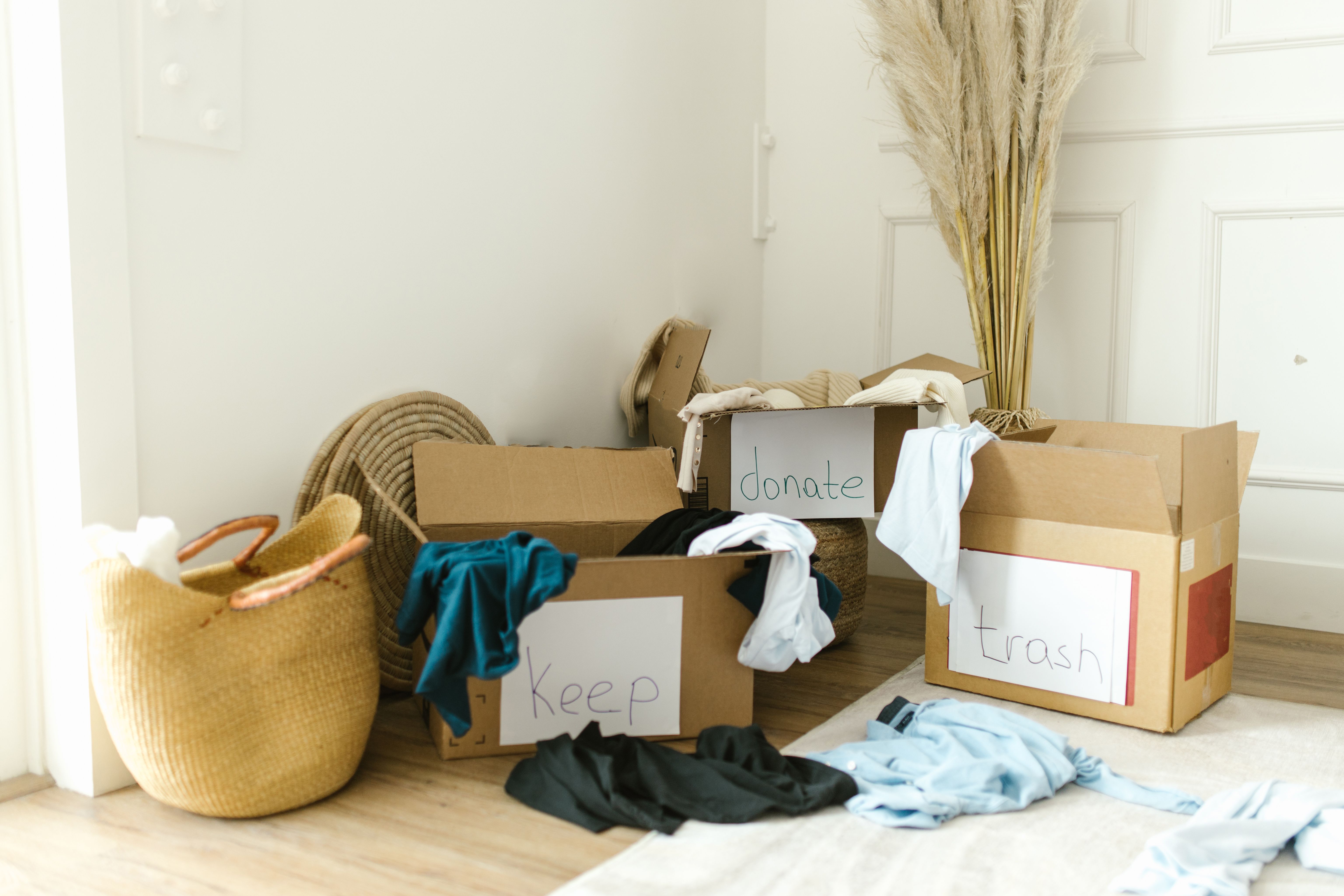
Decluttering sounds simple until you’re actually standing in front of a closet holding something you haven’t used in three years and somehow still can’t bring yourself to get rid of it.
Maybe it was expensive.
Maybe it was a gift.
Maybe you might need it someday.
Maybe you don’t even particularly like it, but throwing it away feels wasteful.
This is where decluttering gets difficult.
The hardest part usually isn’t finding things you obviously don’t want. It’s deciding what to do with everything in the middle — the things that are useful enough, sentimental enough, expensive enough, or potentially useful enough to make you hesitate.
If you’re trying to figure out what to keep and what to get rid of, you don’t need one perfect question.
You need a way to make better decisions.
Here’s how to do that without turning every object in your house into an existential crisis.
Why Is It So Hard to Decide What to Get Rid Of?
Most clutter isn’t made up entirely of things we hate.
If it were, decluttering would be easy.
The difficult items usually come with some kind of attachment:
- You paid good money for them
- Someone gave them to you
- They remind you of a person or time in your life
- They’re still technically usable
- You think you might need them someday
- You feel guilty getting rid of them
- You intended to use them and never did
- They belonged to a previous version of your life
- You worry you’ll regret letting them go
That means decluttering isn’t only about asking whether something is useful.
You’re often weighing usefulness, money, memories, guilt, identity, and future possibilities all at once.
No wonder deciding can feel exhausting.
The goal isn’t to become ruthless.
It’s to get clearer about what deserves space in your home now.

Start With One Important Question: Would You Choose This Again Today?
One of the easiest ways to get unstuck is to stop asking:
“Should I get rid of this?”
That question naturally makes you focus on loss.
Instead, ask:
“If I saw this today and didn’t already own it, would I choose to bring it into my home?”
That changes the decision.
You aren’t deciding whether an item is objectively good or bad. You’re deciding whether it still earns a place in your current life.
If the answer is an immediate yes, keep it.
If the answer is an immediate no, that’s useful information.
If the answer is “well, maybe…” keep going through the questions below.
The 12 Questions to Ask When You Don’t Know What to Keep
You don’t need to ask all twelve questions about every object.
Think of this as a toolbox for the items that make you pause.
1. Do I Actually Use This?
Start with reality.
Not:
Could I use this?
Almost anything could be useful.
Ask:
Do I use this?
If you regularly reach for something, that’s a strong argument for keeping it.
If you haven’t used it in years, the next question is why.
There are legitimate reasons to keep infrequently used items. You probably don’t use a fire extinguisher every week, and seasonal decorations naturally spend most of the year in storage.
But a kitchen gadget you haven’t touched since 2021 deserves a little more scrutiny.
2. When Did I Last Use It?
Time can reveal the difference between an item that’s useful and one that’s merely theoretically useful.
Think about the last time you actually used it.
Was it:
- This week?
- This month?
- Sometime this year?
- Several years ago?
- So long ago that you can’t remember?
There is no universal “six-month rule” or “one-year rule” that works for every item.
Instead, consider how frequently that type of object should reasonably be used.
A winter coat and a waffle maker shouldn’t be judged on the same timeline.
3. Do I Own Something Else That Does the Same Thing?
Duplicates are one of the easiest categories to declutter.
Look for:
- Multiple kitchen tools that serve the same purpose
- Extra water bottles
- Too many towels
- Repeated cleaning products
- Several nearly identical black shirts
- Multiple sets of measuring cups
- Extra phone chargers
- Duplicate tools
- Backup items you forgot you owned
You don’t necessarily need to keep only one of everything.
The question is whether the number you own makes sense for how you actually live.
If you regularly use six bath towels, keep six.
If you own seventeen and can’t explain why, you probably have some room to reduce.
4. Would I Buy This Again?
This is especially useful for clothes, decor, kitchen items, books, and personal belongings.
Imagine the item disappeared.
Would you spend money to replace it?
If yes, that’s a good sign it still has value to you.
If your immediate reaction is:
“Absolutely not.”
That tells you something too.
5. Am I Keeping It Because It Was Expensive?
This one gets a lot of people.
You paid $200 for the coat.
You bought an expensive blender.
You invested in a hobby you never actually enjoyed.
Getting rid of the item can feel like admitting the purchase was a mistake.
But the money has already been spent.
Keeping something you don’t use does not recover that money.
It only means you’re now paying for the mistake with storage space too.
If an expensive item still has resale value, selling it may make the decision easier.
If it doesn’t, ask yourself whether keeping it actually improves your life.
The price you paid in the past does not determine whether the item deserves space in your home today.
6. Am I Keeping It Because It Was a Gift?
Gifts can carry a surprising amount of guilt.
Someone chose this for you.
They spent money on it.
You don’t want to seem ungrateful.
But once a gift is given to you, its job is complete.
You are allowed to appreciate the gesture without keeping the physical object forever.
If you genuinely love and use the gift, wonderful.
If it has spent eight years hidden in a closet because you feel too guilty to donate it, keeping it isn’t making the gift more meaningful.

7. Am I Saving It for My Fantasy Self?
This is one of the sneakiest sources of clutter.
Your fantasy self:
- Makes elaborate homemade bread every weekend
- Wears bold heels
- Scrapbooks
- Camps constantly
- Reads every classic novel
- Uses that exercise equipment
- Throws elegant dinner parties
- Repairs their own furniture
- Has time for six different hobbies
Sometimes those things genuinely are part of your life.
Sometimes they’re part of the life you imagined having.
Look at the item and ask:
Is this supporting something I actually do, or something I think I should do?
You don’t have to give up on future possibilities.
But you also don’t need to store supplies for every possible future version of yourself.
8. Could I Easily Replace It If I Needed It?
This is a very helpful question for “just in case” items.
Suppose you’re keeping something because you might need it someday.
Ask:
If I got rid of this and unexpectedly needed it later, how difficult would it be to replace?
If the answer is:
“Five dollars and a ten-minute trip to the store,”
you probably don’t need to dedicate valuable storage space to it for the next decade.
On the other hand, an expensive specialized tool that’s difficult to replace may be worth keeping even if you use it infrequently.
Consider replacement cost, availability, and inconvenience together.
9. Does This Item Fit My Life Right Now?
Your belongings should support your current life.
Not the life you had ten years ago.
Not the life you planned to have.
Not the life someone else thinks you should have.
Maybe your hobbies changed.
Maybe your style changed.
Maybe you moved somewhere smaller.
Maybe your kids got older.
Maybe you work from home now.
Maybe you don’t entertain the way you used to.
It’s okay for your possessions to change along with you.
10. Do I Have a Real Place to Store It?
Storage space is finite.
Even useful things can become clutter when you own more than your home can reasonably hold.
Ask:
Where will this live?
If the answer is:
“I guess I’ll squeeze it somewhere,”
that’s a sign you may need to make a choice.
Keeping an item means giving it space.
That space has value too.
If deciding where things should live is part of the problem, How to Decide Where Things Should Go in Your Home can help you choose storage locations based on how you actually use your home.
11. Does Keeping This Make My Home Easier or Harder to Manage?
We tend to judge items individually.
But clutter is cumulative.
One extra shirt doesn’t make your closet difficult to use.
Neither does one extra mug.
Or one extra book.
Or one extra container.
It’s the combination of hundreds of those decisions that eventually fills a home.
Ask whether keeping the item contributes to a home that’s easier to use or adds another thing you have to store, move, clean, maintain, or organize.
12. If I Got Rid of This, Would I Truly Miss It?
Imagine the item disappeared tomorrow.
Would you notice?
Would you search for it?
Would you replace it?
Would its absence make your life harder?
Or would you forget about it completely?
Sometimes that answer makes the decision surprisingly obvious.

A Simple Keep, Donate, Sell, Recycle, or Trash System
Once you start making decisions, give everything a destination.
Don’t create one giant “get rid of” pile that you have to sort again later.
Use five basic categories:
Keep
Items you use, love, need, or intentionally want in your life.
Donate
Useful items in good condition that you no longer need.
Sell
Items valuable enough that selling them is genuinely worth your time and effort.
Be realistic here.
If you’ve been “planning to sell” something for two years, the sell pile may simply be delayed clutter.
Give yourself a deadline.
If it isn’t listed or sold by that date, donate it.
Recycle
Paper, cardboard, electronics, textiles, and other items that can appropriately be recycled through services available in your area.
Check local rules because recycling options vary significantly.
Trash
Broken, damaged, contaminated, or unusable items that cannot reasonably be donated or recycled.
You don’t have to find a perfect second life for every object.
Sometimes something has simply reached the end of its useful life.
What About Things You Might Need Someday?
“Someday” is responsible for an impressive amount of clutter.
And sometimes keeping something for later is completely reasonable.
The trick is separating likely future use from hypothetical future use.
Try this test.
Keep the item if:
- You can identify a realistic situation where you’ll use it
- That situation is reasonably likely to happen
- Replacing the item would be difficult or expensive
- You have appropriate room to store it
Reconsider it if:
- You’ve been keeping it for years without using it
- You can’t identify a specific future need
- It’s inexpensive and easily replaceable
- It’s taking up useful storage space
- You own several similar “just in case” items
There is a difference between preparedness and storing everything that might conceivably become useful.
How to Declutter Sentimental Items
Sentimental clutter deserves a different approach.
You’re not keeping these things because they’re practical.
You’re keeping them because they mean something.
That means questions like “Have I used this in the last year?” don’t really apply.
Instead, ask:
- What memory does this represent?
- Do I need the object to keep that memory?
- Is this one of the best examples of that memory or person?
- Does seeing this make me happy, or mostly guilty?
- Would a photo preserve what matters about it?
- How many items do I need to represent this period of my life?
You don’t have to get rid of sentimental belongings just because they aren’t useful.
But you also don’t need to keep every object associated with someone or something important.
Choose representative items
Instead of keeping an entire box of childhood belongings, choose a handful of things that best represent that time.
Instead of keeping every card someone gave you, keep the few that actually mean something.
The goal is not to remove the memory.
It’s to separate the memory from the sheer volume of objects attached to it.
Take photos when the memory matters more than the object
Sometimes you want to remember an item without needing to physically own it.
Photographing it before donating or discarding it can help.
This works especially well for:
- Childhood artwork
- Old school projects
- Large sentimental objects
- Collections you no longer want to store
- Gifts that carry a memory but don’t fit your life
A photo won’t replace every sentimental item, but it can make some decisions easier.
What to Do With Clothes You’re Not Sure About
Clothes tend to create their own category of indecision.
For each questionable item, ask:
Does it fit comfortably right now?
Do I actually like how I look and feel in it?
Have I chosen to wear it when I’ve had other options?
Does it work with my current lifestyle?
Would I buy it again today?
Be especially cautious of clothing you’re keeping because:
- It used to fit
- It was expensive
- It still has tags
- You might wear it to a very specific hypothetical event
- You feel like you should like it
- You bought it for a previous job or lifestyle
Your closet is more useful when it contains clothes you’re genuinely willing to wear.
What to Do With Kitchen Items
Kitchen clutter is often driven by duplicates and aspirational purchases.
Ask:
- Do I use this tool?
- Do I own another tool that does the same thing?
- Is it worth the cabinet space it takes up?
- Could a basic tool do the same job?
- Do I have more than my household realistically needs?
Single-purpose gadgets deserve particular scrutiny.
If you love your avocado slicer and use it three times a week, keep it.
If you forgot you owned it until you found it at the back of a drawer, that’s a different story.

What to Do With Books
You are allowed to get rid of books.
Even good books.
Even books you paid for.
Even books you haven’t read.
Keep books you:
- Love
- Regularly reference
- Genuinely plan to read
- Want to reread
- Enjoy seeing on your shelves
- Would be difficult to replace
Reconsider books you feel obligated to read but have moved from house to house untouched for twelve years.
A bookshelf doesn’t have to function as evidence of every book you’ve ever purchased.
What to Do With Hobby and Craft Supplies
Hobby clutter is difficult because supplies represent possibility.
Maybe you’ll sew again.
Maybe you’ll return to painting.
Maybe you’ll finally make that scrapbook.
Instead of asking whether you could use the supplies, ask whether you’re genuinely interested in the hobby now.
If you are, keep a reasonable amount.
If you aren’t sure, choose your best supplies and reduce the rest.
If you haven’t touched the hobby in years and feel relieved at the thought of letting the supplies go, that tells you plenty.
Use a “Maybe Box” for the Hardest Decisions
If you’re genuinely stuck, create a temporary maybe box.
Put questionable items inside, seal it, and write the date on it.
Then set a deadline — perhaps three or six months depending on what’s inside.
If you need something, take it out.
At the end of the test period, look at what remains.
If you didn’t need, think about, or look for any of those items, letting them go may be much easier.
Just make sure the maybe box has a deadline.
Otherwise, you’ve invented a new storage category called “things I couldn’t decide about.”
Don’t Declutter Your Entire House in One Weekend
You do not need to make hundreds of emotionally loaded decisions at once.
Decision fatigue is real.
The longer you declutter, the more tempting it becomes to either keep everything or get rid of things too quickly just to finish.
Work in small areas.
One drawer.
One shelf.
One clothing category.
One kitchen cabinet.
One box.
Small sessions give you time to make thoughtful decisions without turning your entire home upside down.
If you need a broader plan, How to Organize Your Home: A Practical Step-by-Step Guide walks through the full process in manageable stages.
Declutter Before You Buy More Organizers
One of the easiest mistakes to make is trying to organize everything before deciding what deserves to stay.
That can lead to spending money on containers for belongings you’re eventually going to get rid of anyway.
Declutter first.
Then organize what’s left.
If you’re trying to figure out which process comes first in your home, read Should You Declutter or Organize First?.
And once you’ve decided what’s staying, you don’t necessarily need to run out and buy a collection of storage bins. How to Organize Your Home Without Buying Anything has plenty of ways to use what you already have.
Don’t Keep Things Just Because You Have Space
This is an important one.
Having room for something doesn’t necessarily mean you should keep it.
A basement can fill up.
So can a garage.
So can an attic.
Extra storage can sometimes delay decisions because there isn’t an immediate consequence to keeping something.
But everything you keep still has to be:
- Stored
- Moved
- Cleaned around
- Maintained
- Remembered
- Eventually dealt with
The question isn’t only:
“Can I fit this somewhere?”
It’s:
“Do I actually want to continue owning this?”
How Do You Know When You’ve Decluttered Enough?
You don’t need a specific number of belongings.
You don’t need empty rooms.
And you certainly don’t need to become a minimalist unless that’s something you genuinely want.
You’ve probably decluttered enough when:
- Your storage areas function comfortably
- You can find what you need
- Putting things away is reasonably easy
- You aren’t constantly moving clutter from place to place
- Your home contains mostly things you use, need, or genuinely value
- Everyday cleanup feels manageable
If you’ve decluttered but your home still immediately becomes chaotic, the problem may be your organizing system rather than the amount you own.
Our guide to Why Your Home Won’t Stay Organized (and How to Fix It) covers what to look for next.

Frequently Asked Questions About What to Keep and What to Get Rid Of
How do I decide what to throw away when decluttering?
Start by removing anything broken, unusable, expired, or no longer needed. For harder decisions, consider whether you currently use the item, would buy it again, have something else that serves the same purpose, and would actually miss it if it were gone.
How do I know if something is worth keeping?
An item is generally worth keeping if you use it, need it, genuinely value it, or have a specific and realistic reason to keep it. It should also have an appropriate place in your home without making storage unnecessarily difficult.
What is the best question to ask when decluttering?
A useful question is: “If I didn’t already own this, would I choose to bring it into my home today?” This helps separate your current needs and preferences from guilt, sunk costs, and attachment to past decisions.
What should I get rid of first when decluttering?
Start with easy decisions such as trash, expired products, broken objects, obvious duplicates, items that no longer fit your life, and things you already know you don’t want. Saving sentimental or difficult categories for later can help build momentum.
How do I get rid of things without feeling guilty?
Try identifying the source of the guilt. If the item was expensive, remember that keeping it does not recover the money. If it was a gift, you can appreciate the person or gesture without keeping the object forever. If the item is usable, donating it may also make letting go easier.
Should I keep something because I might need it someday?
Keep “just in case” items when the future need is realistic, replacement would be difficult or costly, and you have reasonable storage space. Reconsider items that are inexpensive, easily replaced, haven’t been used in years, or are being kept for highly unlikely scenarios.
How do I decide what sentimental items to keep?
Choose items that best represent the person, memory, or period of your life rather than keeping every associated object. Ask whether the item itself matters or whether the memory is what you value. For some objects, taking a photograph before letting them go can preserve the memory without requiring physical storage.
What if I regret getting rid of something?
Occasional decluttering regret is possible, but it is usually less common than people fear. For difficult decisions, use a temporary maybe box or wait before getting rid of especially sentimental or irreplaceable items. You don’t need to force yourself into a decision simply to declutter quickly.
Keep What Supports Your Life Now
Decluttering isn’t about proving that you can live with as little as possible.
It’s about making room for the things that actually belong in your life.
Keep the sweater you genuinely love.
Keep the weird kitchen gadget you use every Sunday.
Keep the sentimental box that means the world to you.
You don’t need to justify those things.
But give yourself permission to let go of belongings that exist mainly because you feel guilty, because they were expensive, because you might need them someday, or because they once made sense for a version of your life that no longer exists.
When you’re stuck, come back to the simplest question:
If I didn’t already own this, would I choose it again today?
Your answer doesn’t have to be ruthless.
It just has to be useful.