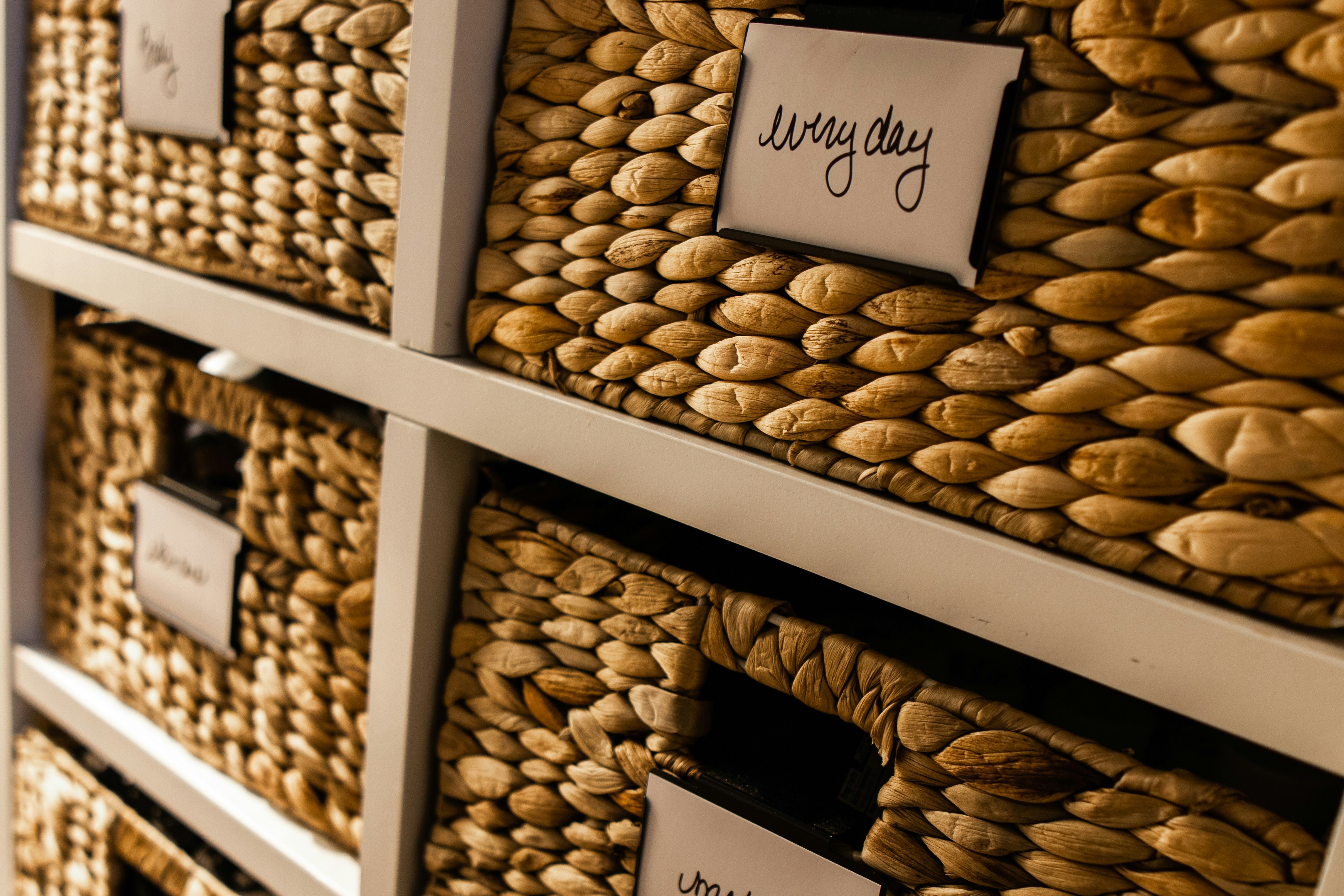
If you’ve decided it’s finally time to organize your home, it’s tempting to look around and immediately see everything that needs to be done.
The kitchen cabinets are overflowing. There’s a pile of mail on the counter. The hall closet has become a place where things disappear. Your bathroom drawers could use some attention. And we won’t even talk about whatever is happening in the basement.
Trying to tackle it all at once is a pretty reliable way to get overwhelmed before you’ve actually organized anything.
Instead, start smaller.
Organizing your home isn’t about transforming every room in a weekend or creating picture-perfect storage systems. It’s about making your space easier to use. The best organizing systems help you find what you need, make putting things away relatively painless, and prevent everyday clutter from taking over quite so easily.
If you’re not sure where to begin, this Home Organization 101 guide walks through the entire process — from choosing your first project to decluttering, deciding where things belong, choosing storage solutions, and keeping your home organized afterward.
What Does It Actually Mean to Organize Your Home?
Home organization is essentially the process of giving the things you own logical, usable places to live.
That sounds simple. In practice, there are a few pieces involved.
A functional organizing system usually makes it:
- Easy to find what you need
- Easy to access the things you use most
- Easy to put things away
- Clear where different categories of items belong
- Possible to see or keep track of what you own
- Harder for unnecessary clutter to accumulate
That last point matters.
A home can look tidy without actually being organized. If you’ve ever frantically shoved everything into a closet before someone came over, you’ve demonstrated this principle beautifully.
Tidying deals with what’s visible. Organizing creates a system for what happens to those things afterward.
And decluttering is different from both.
Decluttering reduces the amount of stuff you have to manage.
Organizing determines where the stuff you’re keeping should go.
Tidying puts that stuff back where it belongs.
All three work together, but understanding the difference makes organizing your home much easier.

Where Should You Start When Organizing Your Home?
Start with one specific area that’s causing you problems.
Not “the kitchen.”
Pick the cabinet where you can never find the food storage lids.
Instead of “the bedroom,” start with the top two dresser drawers.
Instead of “the bathroom,” tackle the cabinet under the sink.
Small projects give you a clear finish line, which is especially helpful when you’re organizing your home for the first time or dealing with a lot of clutter.
You also get to experience whether your new system actually works before repeating it throughout an entire room.
Start With a High-Impact Space
If you have several options, prioritize an area that regularly annoys you.
Think about places where:
- You frequently can’t find something
- Items fall out when you open the door
- You regularly buy duplicates because you don’t know what you already have
- Things consistently end up on a nearby counter or floor instead of being put away
- Putting something away requires moving several other things first
- The space simply doesn’t hold everything currently assigned to it
These aren’t just signs of messiness. They’re clues that the existing system isn’t working particularly well.
Fixing one of those areas can make everyday life noticeably easier, which gives you a much better reason to keep going than organizing something nobody uses.
Step 1: Choose One Manageable Organizing Project
Before pulling everything out of every closet you own, establish a boundary.
Your project could be:
- One drawer
- One cabinet
- One shelf
- One section of a closet
- One countertop
- One category of items
- One small piece of furniture
The size of the project should match the amount of time and energy you actually have.
If you have 20 minutes, organize a drawer.
If you have an hour, tackle a cabinet.
If you’ve set aside an afternoon, you might reasonably take on a closet.
You do not receive extra points for turning your entire house upside down simultaneously.
Step 2: Take Everything Out — When It Makes Sense
You’ve probably heard the standard organizing advice: remove everything from the space before you begin.
Sometimes that’s exactly what you should do.
Emptying a drawer or cabinet lets you see everything you own, clean the space, group similar items, and reconsider how you’re using the available storage.
But use some judgment.
Emptying an entire basement onto the floor is a considerably different undertaking than emptying a junk drawer.
For larger spaces, work section by section. Finish one shelf, zone, or category before moving to the next.
The goal is to create manageable decisions, not a bigger mess that you’re too exhausted to finish.

Step 3: Group Similar Items Together
Before deciding where anything should go, see what you actually have.
Group similar items into categories.
In a kitchen, for example, you might group:
- Baking supplies
- Food storage containers
- Snacks
- Canned goods
- Spices
- Small appliances
- Cooking utensils
- Dish towels
Don’t worry about containers or labels yet.
Simply seeing similar items together can reveal organizational problems immediately.
You might discover that you own six nearly identical spatulas, three open bags of brown sugar, or enough reusable water bottles to hydrate a small soccer team.
Which brings us to decluttering.
Step 4: Declutter Before You Organize
One of the most common home organization mistakes is trying to organize too much stuff.
Storage products can help you use space more efficiently, but they can’t create unlimited space.
Before deciding where everything belongs, go through each category and ask:
Do I use this?
Do I actually want this?
Would I notice if it were gone?
Do I own another item that serves the same purpose?
Is it broken, expired, incomplete, or otherwise unusable?
Would I buy this again today?
You don’t need to get rid of things simply for the sake of owning less. The goal is to identify items that are taking up valuable storage space without providing much value in return.
Create separate places for items you want to:
- Keep
- Donate
- Sell
- Recycle
- Throw away
- Move somewhere else
Then actually deal with those outgoing piles. A bag labeled “donate” sitting in your bedroom for four months is technically just a new category of clutter.
Step 5: Decide Where Things Should Live
Now you’re ready for the actual organizing.
One of the most useful questions you can ask is:
Where do I use this?
Whenever possible, store things close to where they’re used.
Coffee supplies make sense near the coffee maker.
Dish towels belong somewhere near the sink.
Dog-walking supplies are probably more useful near the door than tucked into a distant closet.
Then consider how frequently you use each item.
Prime Storage
Your easiest-to-reach storage should generally hold things you use regularly.
That means:
- Frequently used kitchen tools in accessible drawers
- Everyday toiletries within easy reach
- Daily clothing in convenient parts of your closet
- Regularly used pantry staples around eye level
Secondary Storage
Less convenient areas can hold things you use occasionally.
Think:
- Holiday serving dishes
- Specialty appliances
- Extra linens
- Seasonal clothing
- Bulk household supplies
- Keepsakes
You don’t need your turkey roasting pan occupying prime kitchen real estate if you use it twice a year.
Store Things With Their Friends
Grouping related items makes it easier to remember where things belong.
Instead of storing batteries in three different rooms, create one battery location.
Put baking supplies together.
Keep gift-wrapping materials together.
Group first-aid supplies.
Create a home for pet supplies.
The exact categories will depend on your household. What matters is that the grouping makes intuitive sense to the people using it.
Step 6: Make Things Easy to Put Away
This might be the most overlooked rule of home organization.
Putting something away should ideally be at least as easy as leaving it out.
If putting away your everyday bag requires opening a closet, moving a vacuum cleaner, reaching behind three coats, and hanging it on a tiny hook, there’s a pretty good chance that bag is going to live on a chair.
That’s useful information.
Look at where clutter naturally accumulates and ask why.
If shoes pile up by the door, maybe shoe storage belongs there.
If mail collects on the kitchen counter, create a small mail system nearby.
If blankets always end up on the couch, a basket beside the couch might work better than a linen closet down the hall.
Instead of constantly fighting your household’s habits, build organizing systems around them.
Step 7: Use Containers Only When They Solve a Problem
You do not need to buy storage bins before organizing your home.
In fact, it’s usually better not to.
Declutter and categorize first. Then you’ll know exactly:
- What needs to be stored
- How much of it you have
- Where it will live
- How much space is available
Only then should you decide whether a storage product would make that space work better.
Useful organizing tools might include:
- Drawer dividers
- Baskets
- Clear bins
- Opaque storage boxes
- Shelf risers
- Turntables
- Hooks
- Over-the-door organizers
- Pull-out cabinet organizers
- Stackable containers
- Labels
The important question isn’t whether an organizer looks good.
It’s what problem does this solve?
If you can’t answer that, you probably don’t need it.

Step 8: Measure Before Buying Organizers
If you do need storage products, measure first.
Measure the:
Width × depth × height
of the available space.
Then account for doors, hinges, pipes, shelf supports, baseboards, handles, and anything else that reduces usable space.
For drawers, make sure an organizer isn’t taller than the drawer itself.
For cabinets, check whether bins can actually be pulled out once the door is open.
For shelves, consider whether you’ll be able to remove a container when the shelf above it is full.
A storage bin that’s half an inch too large isn’t an organizing solution. It’s a return.
Step 9: Label Selectively
Labels can be extremely helpful, but you don’t need to label everything you own.
They’re most useful when:
- Several people use the same storage area
- Containers aren’t transparent
- Categories could easily become mixed
- You’re creating a new system
- Items are stored somewhere that isn’t immediately obvious
- You want everyone in the household to know where something belongs
A label isn’t just there to help you find something.
It tells you where to put it back.
And handwritten masking tape works perfectly well if you aren’t ready to commit to a permanent system yet.
Step 10: Test Your New Organizing System
Don’t assume an organizing system is finished just because it looks good.
Use it.
Give yourself a couple of weeks and pay attention.
Are things actually getting put away?
Can everyone find what they need?
Is something constantly ending up in the wrong place?
Does one category need more space?
Is there an annoying extra step you could eliminate?
Good home organization involves experimentation.
If something isn’t working, change it.
The system is supposed to serve you — you’re not supposed to serve the system.
How to Organize Your Home Without Getting Overwhelmed
If your whole house feels cluttered, zoom in.
Don’t repeatedly walk through every room mentally cataloging everything that needs attention. Choose the next small area and work on that.
A simple approach is:
- Choose one manageable space.
- Remove or review what’s inside.
- Group similar things together.
- Declutter what you don’t need.
- Decide where the remaining items should live.
- Use storage products only if they solve a specific problem.
- Put everything away.
- Live with the system and adjust it if necessary.
Then move on to another space.
Your house became cluttered gradually. It can become organized gradually too.
Common Home Organization Mistakes
Understanding what doesn’t work can save you quite a bit of effort.
Buying Organizers Before Decluttering
A beautiful set of bins won’t solve the problem if you simply have more stuff than the space can comfortably hold.
Figure out what you’re keeping first.
Organizing for Appearance Instead of Function
Matching containers can look fantastic while making everyday items irritating to access.
Function comes first. You can make it pretty afterward.
Creating Too Many Categories
Overly specific systems require more decisions.
If everyone has to determine whether an item belongs in “charging accessories,” “electronics,” “computer accessories,” or “miscellaneous cords,” there’s a decent chance everything will eventually end up in the nearest drawer.
Use categories that are specific enough to be useful but broad enough to maintain.
Making Things Hard to Put Away
If a storage system requires too many steps, people stop using it.
Look for opportunities to remove lids, add hooks, use open baskets, move frequently used items closer, or otherwise reduce friction.
Filling Every Inch of Available Storage
Empty space isn’t wasted space.
A drawer that’s 80% full is easier to use than one packed so tightly you have to rearrange it every time you need something.
Leaving some breathing room also gives you flexibility when new items enter your home.
Trying to Organize Everything at Once
This is how you end up sitting on the floor surrounded by six years of paperwork wondering what went wrong.
Finish one project before creating three more.
How Long Does It Take to Organize a House?
There’s no useful universal answer.
It depends on the size of your home, how much you own, your available storage, how much decluttering is necessary, and how much time you can realistically dedicate to the process.
Instead of setting a deadline for your entire house, estimate individual projects.
A drawer might take 15 minutes.
A cabinet could take 30–60 minutes.
A closet might take several hours.
A garage may be a multi-day project.
Breaking home organization into smaller projects makes progress much easier to see — and much easier to continue.

How Do You Keep Your Home Organized?
The goal isn’t to never create clutter again.
You live there. Things are going to move around.
The goal is to make resetting your home relatively easy.
A few habits help:
Put things near where they’re used. This makes putting them away easier.
Give new items a home. If something enters the house without somewhere to live, it’s likely to become clutter.
Reset small spaces regularly. Five minutes spent putting things back can prevent a much larger project later.
Watch your problem areas. If the same space repeatedly becomes messy, reconsider the system instead of repeatedly reorganizing it the same way.
Declutter periodically. Your possessions and needs change. Your storage should change with them.
Leave room. Don’t organize every container and cabinet to maximum capacity.
The easier your systems are to maintain, the less time you’ll spend reorganizing them.
Home Organization FAQ
What is the best way to start organizing your home?
Start with one small, high-impact area rather than trying to organize an entire room or house at once. Remove what doesn’t belong, group similar items, declutter what you don’t need, and assign logical homes to what remains.
Should you clean or organize first?
If the space is cluttered, declutter and organize before doing a thorough cleaning. However, once you empty a drawer, cabinet, or shelf, it’s a great opportunity to wipe down the empty space before putting things back.
Should you declutter or organize first?
In most cases, declutter first. There’s little benefit in spending time and money creating storage systems for things you don’t actually want or use.
What room should you organize first?
There isn’t one correct room. Start with a space that causes frequent frustration and is small enough to finish in the time you have. Completing one useful project can make it easier to tackle larger areas later.
Can I organize my home without buying anything?
Absolutely. Decluttering, moving items closer to where they’re used, grouping similar things together, repurposing containers, and changing how you use existing storage can make a significant difference without buying new organizers.
How do you organize when you have too much stuff?
Start by decluttering rather than trying to find storage for everything. Work through small categories or areas at a time, remove things you no longer need, and then organize what remains based on where and how frequently you use it.
Why can’t I keep my house organized?
If the same spaces repeatedly become cluttered, the organizing system may not fit your habits. Common problems include owning more than the available storage can hold, storing items far from where they’re used, creating overly complicated categories, or making frequently used things difficult to put away.
Start Small and Make Some Room
You don’t need an empty weekend, a label maker, or a cart full of matching storage bins to start organizing your home.
Pick one space that’s bothering you.
Figure out what’s actually there. Get rid of what you don’t need. Give the things you’re keeping sensible places to live. Make those places easy to use.
Then see how it works.
When you’re ready, choose another space.
Eventually those individual drawers, cabinets, closets, and corners start adding up to something much bigger: a home that works a little better for the people living in it.
And that’s really the point.
Leave a Reply